Remotely controlled USB hub
This is no fancy project, but I thought it might be useful for someone out there. There is probably better ways to do this, but this is what I came up with.
My situation
For those who haven't read my previous post [1], I have recently bought two (yes, TWO!) Rigol DP832 power supplies to power my lab equipment. (I really love them and will never use a non-programmable power supply without ethernet interface again.)
One of those power supplies is located in the "project corner" of my lab, while the other one is located in reach of my computer desk. This means that I often need to move back and forth between those two locations to turn on/off or change voltage/current settings on the power supplies.
This was the main reason why I bought the PSUs with ethernet interface, so I could control them remotely from my computer desk.
However, one project I'm currently working with requires an USB cable to be connected during POR to boot into DFU mode. I already have a long USB cable running from my computer desk to the project corner, but I don't want to unplug/replug the USB cable every time I need to flash the device.
So I needed a USB hub that I could control remotely to connect/disconnect the USB cable to the board.
USB Hub
As I already had my DP832 power supplies, I was looking for a simple USB hub that I could power externally using one of the channels on the supply.
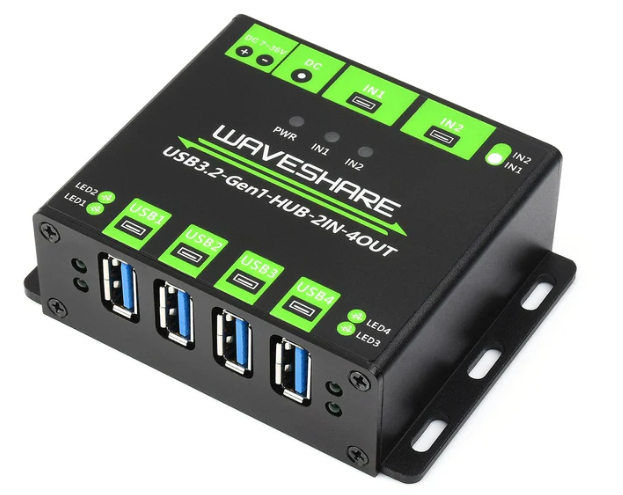
The choice fell on this Industrial USB 3.2 Hub [2] which has a separate power input and is quite compact.
Hardware modification
What I basically want to do is disconnect the power from the USB cable to the hub and only power it from the external power source.
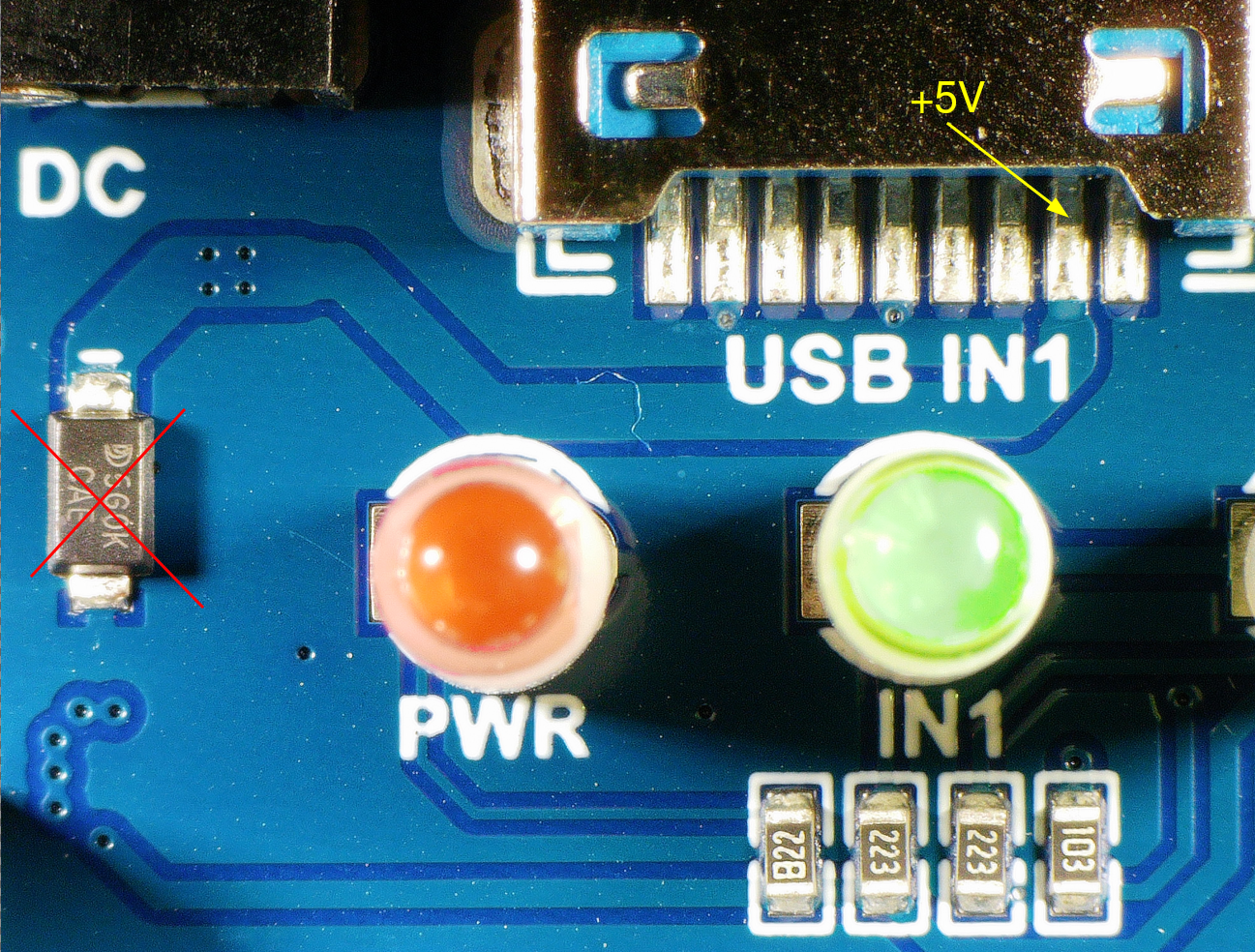
Pin 2 on the USB connector is +5V. Following the traces on the PCB we can see that it goes via a component to ground. The 5G0K marking indicate that it is probably a TVS (Transient Voltage Suppressor) diode. It could be left as is, but I decided to remove it.
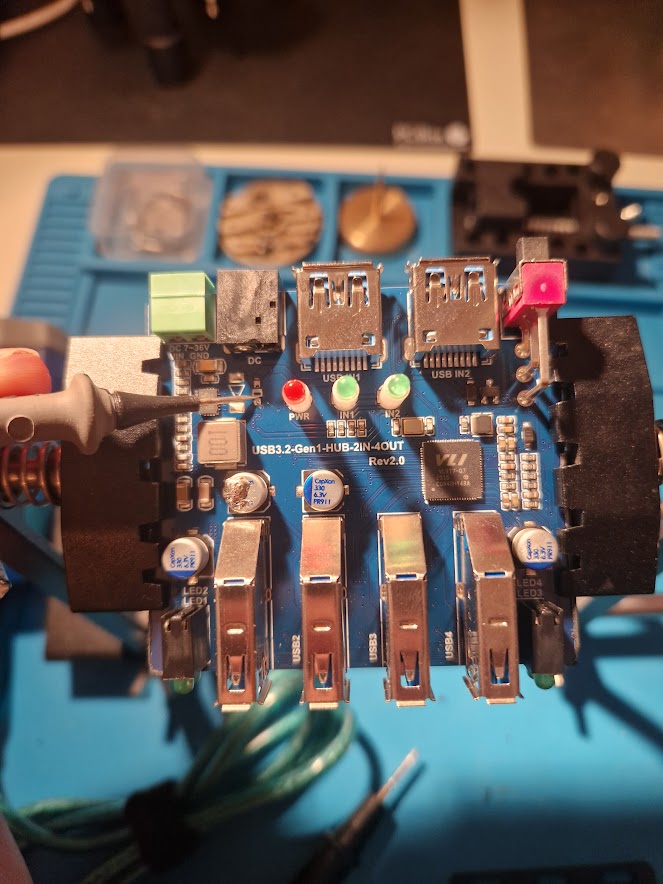
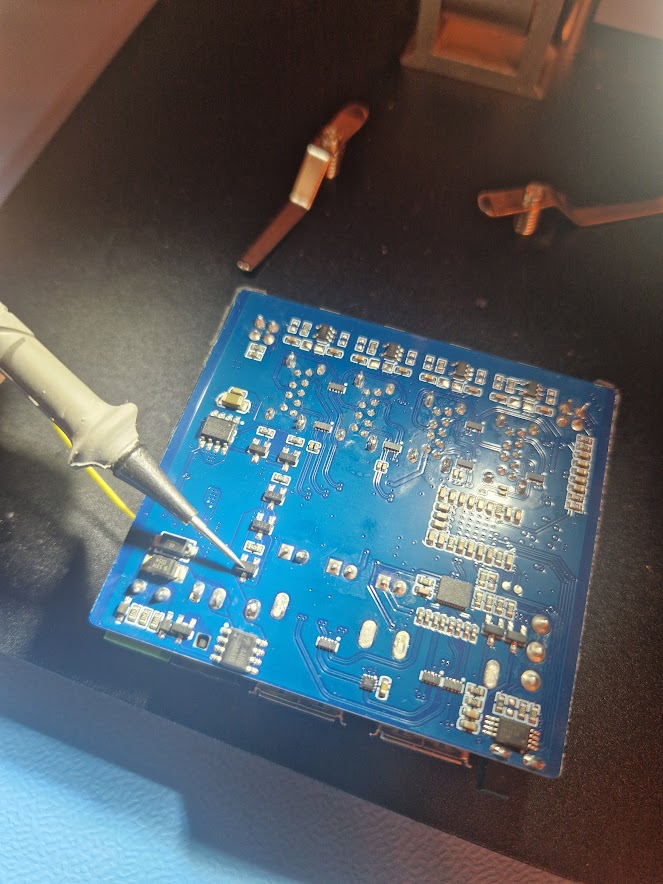
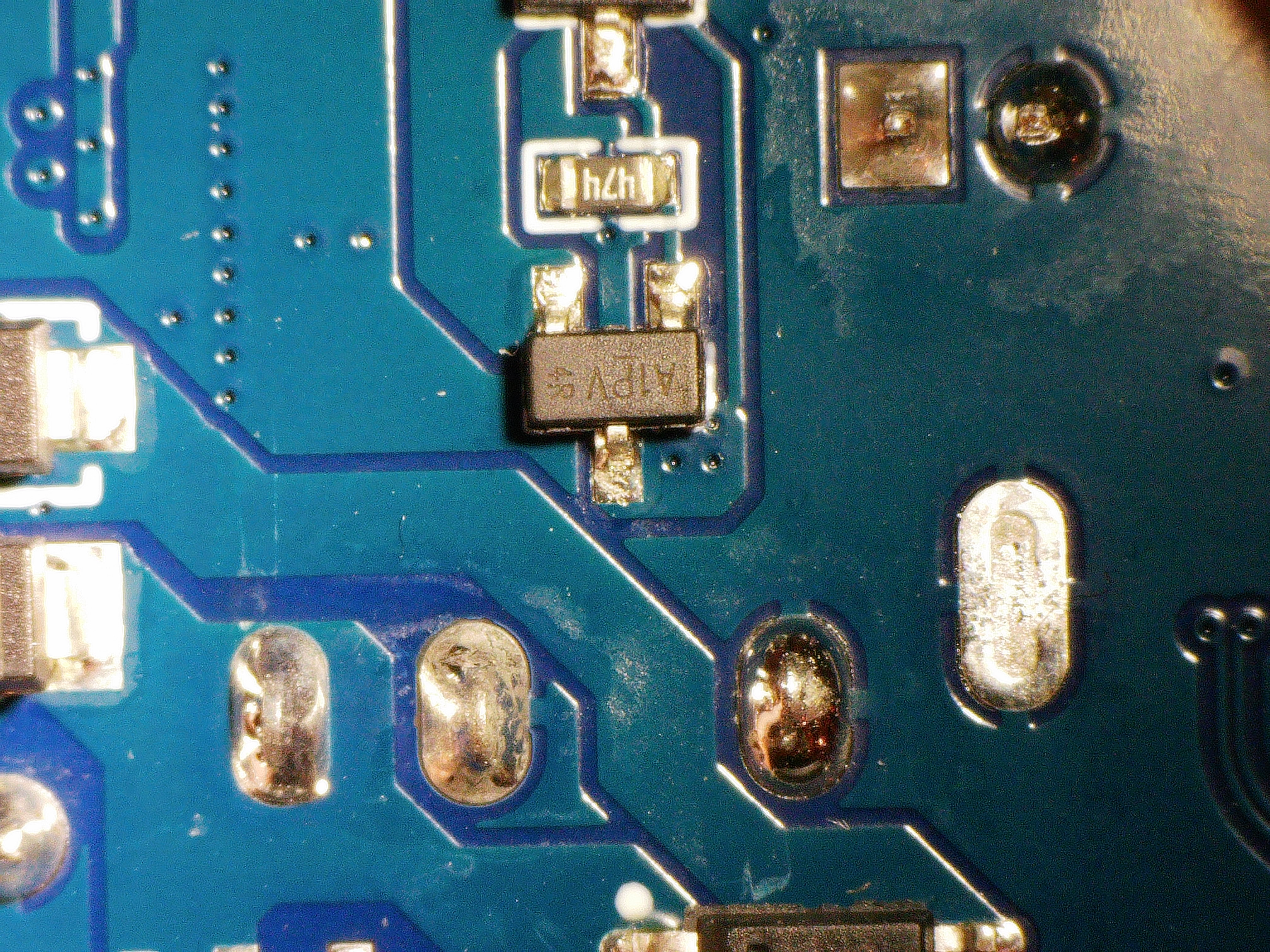
On the bottom plane we can see that the +5V trace goes to a SOT-23 package component. It is probably a transistor used to switch the power from the USB cable to the hub, or just another transient protection, I'm not sure here.
In any case, it should be removed as well.
Result
The result is that when the USB cable is plugged in, the hub does not get any power from it and is only powered from the external power source - which I can control remotely from my computer desk.
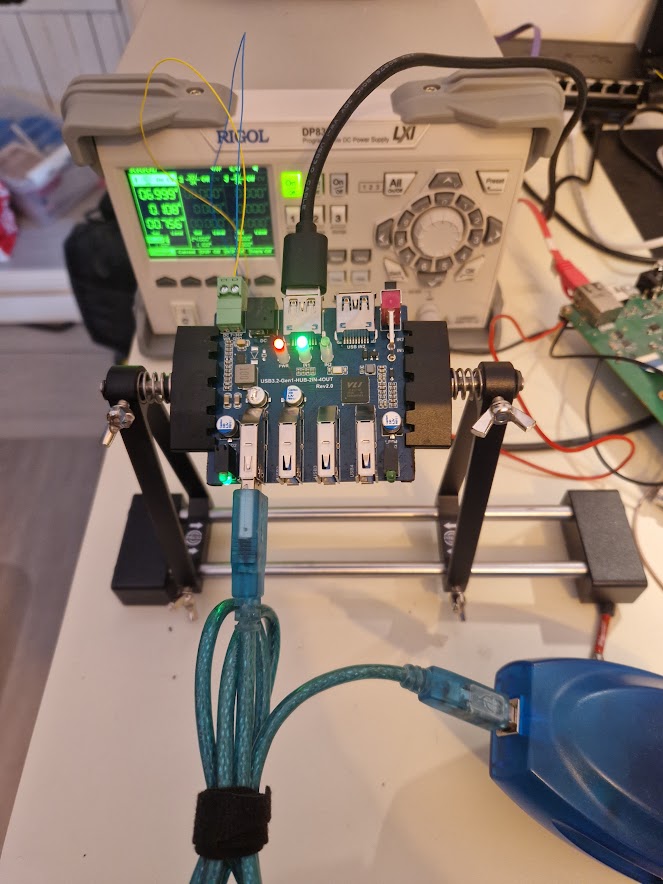
One bonus is that the hub have two USB host inputs that can be selected using a switch on the hub, so the hub still works as usual on the other port.
This will also be useful for devices that is solely powered from USB (e.g. Raspberry Pi), as I can now completely power cycle them remotely.