Marcus Folkesson

Embedded Linux Artist

Linux driver for PhoenixRC adapter

Linux driver for PhoenixRC adapter Update: Michael Larabel on Phoronix has written a post [3] about this driver. Go ahead and read it as well! A few years ago I used to build multi rotors, mostly quad copters and tricopters. It's a fun hobby, both building and flying is incredible satisfying. The first multi rotors i built was nicely made with CNC cutted details. They looked really nice and robust. cover

get_maintainers and git send-email

get_maintainers and git send-email Many with me prefer email as communication channel, especially for patches. Github, Gerrit and all other "nice" and "user friendly" tools that tries to "help" you to manage your submissions does not simply fit my workflow. As you may already know, all patches to the Linux kernel is by email. scripts/get_maintainer.pl (see [1] for more info about the process) is a handy tool that takes a patch as input and gives back a bunch of emails addresses.

OOM-killer

OOM-killer When the system is running out of memory, the Out-Of-Memory (OOM) killer picks a process to kill based on the current memory footprint. In case of OOM, we will calculate a badness score between 0 (never kill) and 1000 for each process in the system. The process with the highest score will be killed. A score of 0 is reserved for unkillable tasks such as the global init process (see [1]) or kernel threads (processes with PF_KTHREAD flag set). cover

printk()

printk() So, a week in Prague has come to its end. The Embedded Linux Conference Europe was this year co-located with Open Source Summit and offered a lot of interesting talks on various topics. One of the hottest topics this year was about our most beloved debugging function - prink(). What is so hard with printing? It turns out that printk is quite deadlock-prone and that is not an easy thing to work around in the current infrastructure of the kernel.

Memory management in the kernel

Memory management in the kernel Memory management is among the most complex parts in the Linux kernel. There is so many critical parts such as page allocator, slab allocator, virtual memory handling, memory mapping, MMU, IOMMU and so on. All these parts have to work perfect (or at least almost perfect :-) ) because all systems do use them whether they want to or not. If there is a bug or performance issue you will be noticed quite soon.

MMAP memory between kernel and userspace

MMAP memory between kernel and userspace Allocate memory in kernel space and then let the userspace map it to their virtual address space sounds like an easy task, and sure it's. There are just a few things that is good to know about page mapping. The MMU (Memory Management Unit) contains page tables with entries for mapping between virtual and physical addresses. These pages is the smallest units that the MMU deals with.

PID1 in containers

PID1 in containers What is PID 1 The top-most process in a UNIX system has PID (Process ID) 1 and is usually the init process. The Init process is the first userspace application started on a system and is started by the kernel at boottime. The kernel is looking in a few predefined paths (and the init kernel parameter). If no such application is found, the system will panic().

2.2" TFT display on Beaglebone

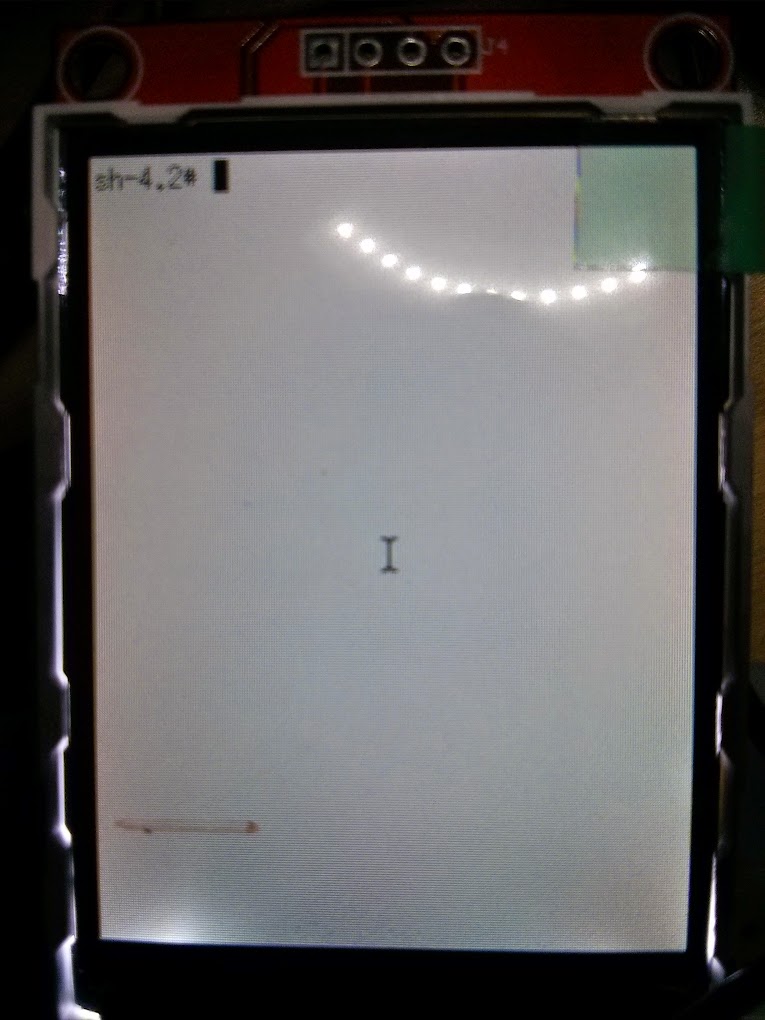
2.2" TFT display on Beaglebone I recently bought a 2.2" TFT display on Ebay (come on, 7 bucks...) and was up to use it with my BeagleBone. Luckily for me there was no Linux driver for the ILI9341 controller so it's just to roll up my sleeves and get to work. Boot up the BeagleBone I haven't booted up my bone for a while and support for the board seems cover

High resolution timers

High resolution timers Nearly all systems have some kind of Programmable Interrupt Timer (PIT) or High Precision Event Timer (HPET) that is programmed to periodically interrupt the operating system (if not configured with CONFIG_NO_HZ). The kernel performs several tasks in these ticks such as timekeeping, calculate statistics for the currently running process, schedule a new process and so on. The interrupt occurs at regular intervals - exactly HZ times per second.

Modules with parameters

Modules with parameters Everybody knows that modules can take parameters, either via /sys/modules/<module>/parameters, sysctl or via cmdline to the kernel, but how are these parameters created? Parameters without callbacks The Linux kernel provides the module_param() macro. The syntax is: 1module_param(name, type, perm) Which will simply create the module parameter and expose it as an entry in /sys/modules/<module>/parameters. Code example 1int debug_flag; 2module_param(debug_flag, bool, S_IRUSR | S_IWUSR | S_IRGRP) 3MODULE_PARM_DESC(debug_flag, "Set to 1 if debug should be enabled, 0 otherwise"); MODULE_PARM_DESC() is a short description of the parameter.